
There are days when I want my face to stop talking in the way you lower the volume on a room when you’ve been listening too hard for too long. Some mornings I look in the mirror and realize my face looks alert in a way I can’t sustain, like it’s ready to respond to questions I haven’t been asked yet.
On those days I don’t want a “lift.” I don’t want snatched. I don’t want anything that implies I’m trying to impress a camera, even if no camera is there.
I want quiet. I want my features to look softened, steady, unremarkable in the best way. I want to look like someone who slept, drank water, and has nothing to prove, even if the truth is that I answered too many messages and went to bed with my brain still buzzing.
So I have a brow routine I only do on those days. It’s not dramatic. It’s not transformative. It’s a small system that makes my expression softer and less readable from across the street, which, for me, can feel like relief.
The emotional reason I focus on brows first
When I’m low on energy, I don’t want a full makeup routine. I don’t want to “get ready.” I want one or two small adjustments that make me feel more comfortable in my own face.
Brows are that for me because they sit at the center of expression. They can make me look sharper than I feel, and that mismatch is what makes me self-conscious. When my brows are too defined, my face looks like it’s asking for engagement, and then I feel like I have to live up to that.
Quiet brows help me match my outside to my inside, which is not a cosmetic goal so much as a psychological one.
The routine, as I actually do it in my bathroom
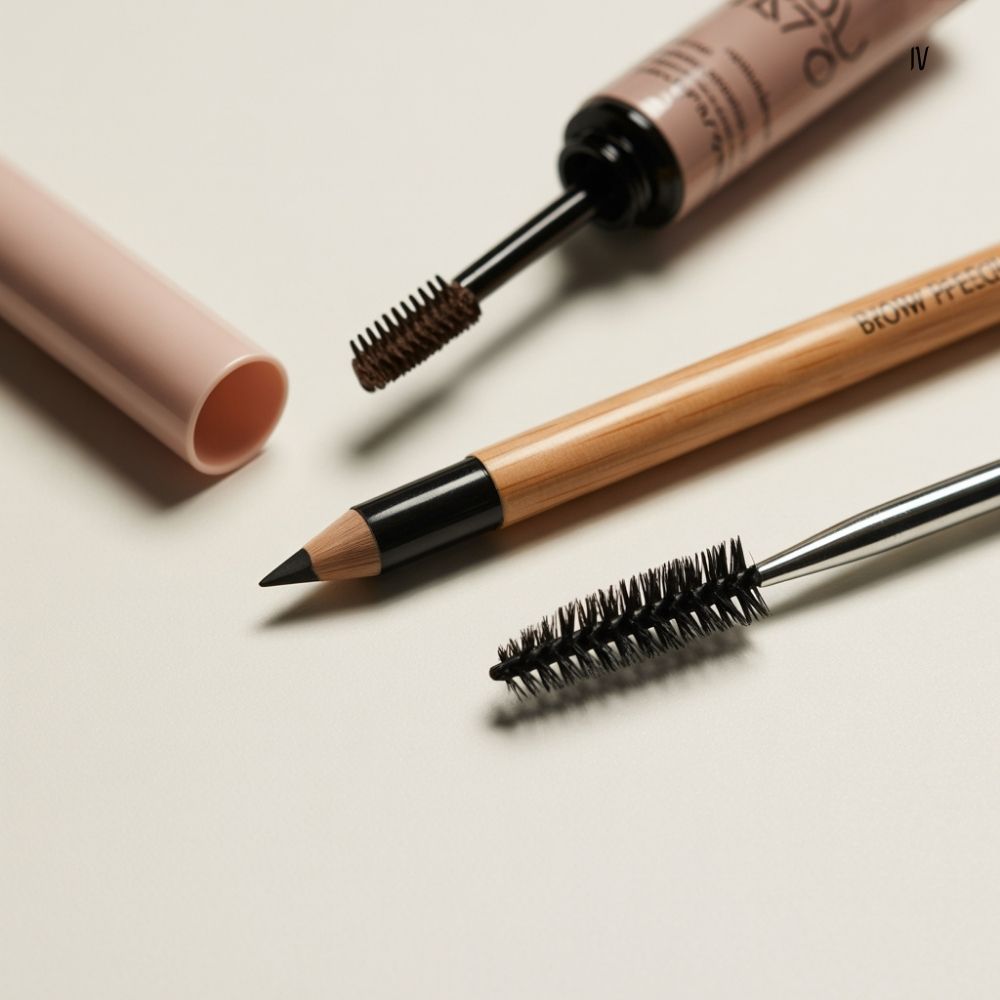
My bathroom shelf looks like chaos, but it’s a system, and my brow routine lives in the smallest corner of it. I do not have five brow products. I have one pencil, one tinted gel or clear gel, and a spoolie brush that has survived years of being tossed into makeup bags and still works.
This is a three-part routine: brush, fill only where needed, then soften.
Step 1: Brush brows up and out, but not into a new personality
I start by brushing my brows upward at the front and outward through the tail, following the direction they naturally want to go. I’m not trying to create that extreme laminated effect where every hair stands at attention. That looks great on other people, but on me it makes my face feel louder.
I’m just waking the brows up and seeing where the gaps are, because gaps are what makes me overfill if I don’t notice them clearly.
Step 2: Fill only the places that interrupt the calm
Here’s the part that keeps it quiet: I don’t fill the whole brow, and I don’t draw a line.
I take a pencil that is slightly cooler and softer than my hair color, and I make tiny strokes only where the brow loses density, usually at the arch and toward the tail. If I fill the front, it becomes obvious too fast. The front of the brow is where harshness starts. I leave it mostly alone.
If I make a mistake, I don’t correct it with more pencil. I correct it by brushing through it. The spoolie is the reason this routine works, because it turns pigment into shadow instead of line.
Step 3: Set with gel, but choose a finish that doesn’t shine
I use a tinted gel if I want extra softness or if my brows are looking slightly faded, and I use clear gel if I want to disappear as much as possible. Either way, I wipe most of the product off the wand first because too much gel makes brows look wet.
I comb the gel through lightly, focusing on keeping the tail tidy, then I press the front of the brow down gently with my fingertip so it doesn’t look spiky. The goal is a soft gradient at the front, not a strong block.
The hack that keeps it from looking harsh: the “one-swipe tissue” trick
This is the practical hack I use almost every time, and it’s the small thing that keeps the routine from tipping into “done brows.”
After I fill and set, I take a tissue and do one very light swipe across the front part of my brows, not the tail, just the inner third. It removes any excess pigment or gel that might be clinging to the skin underneath the hairs, which is usually what makes brows look heavy.
The first time I did this, it felt counterintuitive, like I was undoing my work, but that’s exactly why it works. Quiet makeup is often about removing evidence.
If you’ve ever done your brows and thought, I look a little intense today, this is the fix. One tissue swipe and a quick spoolie blend, and the whole face softens.

What I avoid on quiet-brow days
I avoid carving out the underside of the brow with concealer. It looks clean, but it also looks like makeup, and it creates a sharpness that makes the face feel edited. Edited faces invite attention. Quiet faces don’t.
I also avoid dark pencils and overly warm tones. Warm brow products can turn orange on some skin in certain light, especially under bright bathroom lighting, and then you end up adding more product to correct it, and suddenly it’s a whole situation. Cool and soft is safer.
I avoid heavy tail definition too. A sharp brow tail points your face like an arrow. That can be beautiful, but it’s not quiet.
Final Thoughts
I used to treat brows as the place where you prove you know what you’re doing. Now I treat them as the place where you can soften your whole presence without changing your entire face.
My quiet brow routine is small, repeatable, and built for real mornings when I don’t want attention and I don’t want to perform polish, but I still want to feel like myself. I brush, I fill only where necessary, I soften, and I do the tissue-swipe hack that erases the harshness before it has a chance to settle in.
It’s not a makeover. It’s not a trend. It’s just a way of turning down the volume, which, on certain days, feels like the most practical kind of beauty I know.