
I’m not a person who enjoys running out of things. For me it’s a tiny rupture in the feeling that my life is contained, and that rupture has a way of making my mind louder than the situation deserves.
It’s rarely about the item itself. It’s about the cascade of decisions that follows. If I run out of olive oil, dinner becomes a new plan. If I run out of pasta, I start improvising. If I run out of coffee, I start bargaining with my morning.
Running out forces creativity, and I like creativity in theory, but not when I’m tired, hungry, or already mentally crowded. In those moments, creativity feels less like freedom and more like pressure.
So I’ve built a quiet system around this. There are pantry items I always replace before they run out, because the cost of waiting is not the extra trip to the store, it’s the mental static that comes from realizing you don’t have the basics.
This post is not meant to be a perfect pantry guide, and it’s not an invitation to hoard. It’s simply the items that I’ve learned to replace early because they hold up the structure of my week, especially on the days when I don’t have energy to think about food like it’s an artistic project.
Olive oil, because it’s the base of almost everything I actually cook
In Italy, this feels almost too obvious, but I include it because it’s the single item that changes the feel of my entire kitchen. If I’m out of olive oil, everything becomes harder, and by harder I mean less appetizing.
Vegetables feel sad. Pasta feels flat. Beans feel unfinished. Even toast feels less like a meal and more like a placeholder.
I keep one bottle I use daily and one backup bottle that lives in the back, because olive oil is not something I want to discover I’m out of while the pasta water is already boiling. That is the kind of moment that makes me feel strangely angry at my own life, which is never really about the oil.
Pasta, because it’s my most reliable “no thinking” dinner
When I’m tired, pasta gives me a predictable path to food, and predictability is calming. I keep at least two shapes on hand, usually spaghetti for the obvious reason and something shorter like rigatoni or mezzi rigatoni for the nights when I want a sauce that clings without effort.
I replace pasta before it runs out because it covers too many situations, and because it has a long shelf life, which makes it one of the few kitchen decisions that is always rational. I’m not buying pasta in a panic. I’m buying it in anticipation of a normal week.
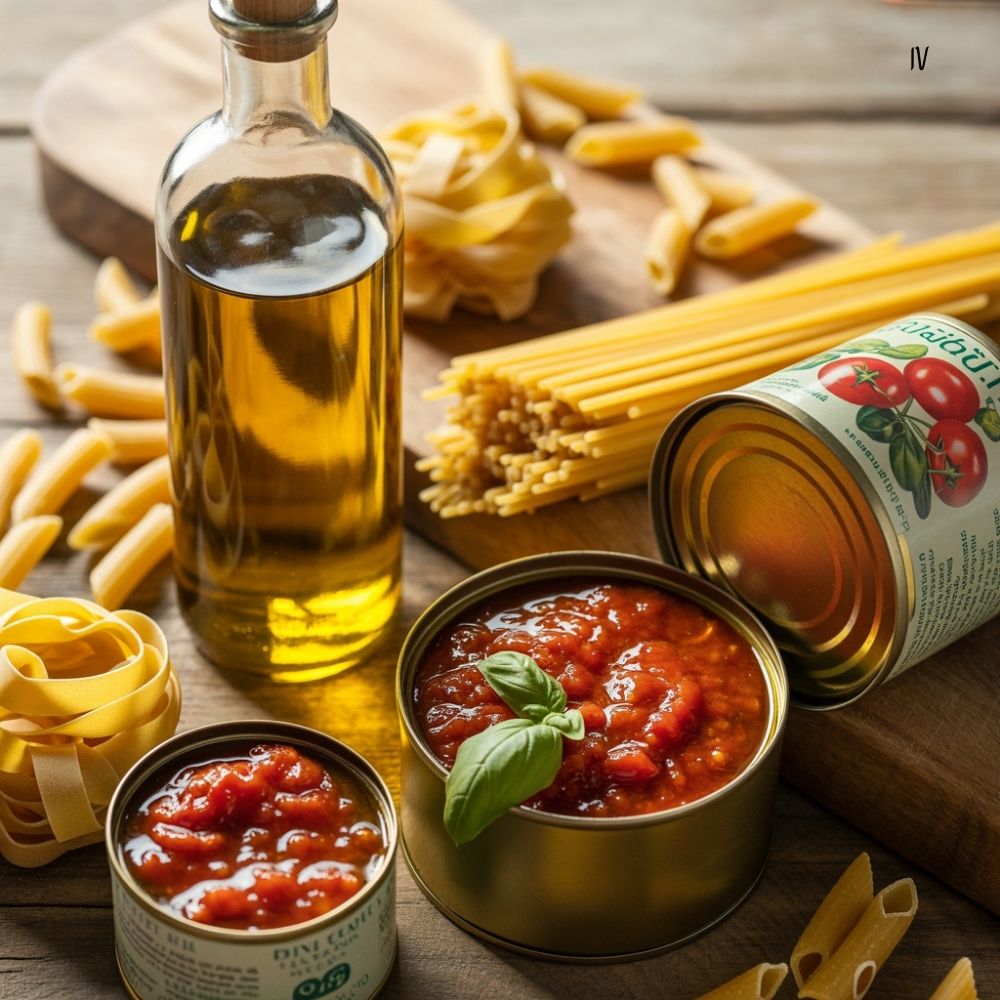
Tinned tomatoes or passata, because it turns the pantry into a meal
If I have pasta and olive oil, I can eat. If I have tomatoes as well, I can eat in a way that feels like dinner.
I always keep at least two jars or cans, because tomatoes are the foundation of quick sauce, soup, and the kind of simmered comfort food that makes your apartment feel warmer than it is. They also let you improvise without becoming chaotic, because tomatoes provide a structure that a handful of random ingredients can join.
Tomatoes are not exciting, but they make my life easier, and that is one of my main criteria for keeping anything.
Canned beans, because they make hunger less dramatic
I keep chickpeas and cannellini beans, and I replace them before they run out because they solve the specific problem of “I have nothing” in a way that is honest.
Beans become a salad with lemon and olive oil. Beans become a soup with garlic and broth. Beans become something mashed onto toast with pepper. They are protein that doesn’t require planning, and they keep me from turning hunger into a mood.
If I can eat something steady quickly, I make fewer irrational choices afterward. This is not willpower. It’s biology. Beans keep me stable.
Salt, because it is the difference between edible and satisfying
Running out of salt sounds like something that only happens to people who don’t cook, but it can happen in a small kitchen when you assume you have plenty and then suddenly you don’t. Salt is not just seasoning. Salt is how food tastes like food.
I keep two kinds, a fine salt for cooking and a flaky salt for finishing, not because I’m trying to be refined, but because flaky salt makes simple meals taste more intentional. A little crunch of salt on eggs or tomatoes changes the whole experience.
When I’m eating for stability, I don’t want bland food, because bland food makes me want snacks. Salt prevents the snack spiral.
Vinegar or lemons, because acidity makes simple food feel complete
I always keep one dependable acid in the kitchen, because it’s the easiest way to make basic ingredients taste alive.
Sometimes it’s lemons. Sometimes it’s vinegar, usually red wine vinegar or apple cider vinegar, something that plays well with vegetables and beans. Acid is what turns “ingredients” into “a dish,” especially when you don’t have energy to do much else. It brightens soups, lifts salads, and makes leftovers feel less heavy.
If I’m out of acid, everything tastes flatter, and flat food doesn’t soothe me. It just fills me.

A small stash of broth or bouillon, because warmth is calming
I keep broth cubes or a jar of bouillon paste, and I replace it early because it’s my quickest route to something warm.
Warmth matters when your mind is loud. A bowl of broth with rice, or with greens, or with an egg stirred in, is one of the most reliable ways I know to calm myself without pretending food can solve emotional problems. It doesn’t solve them. It supports the body while you deal with them.
Bouillon is also the ingredient that turns “I don’t know what to cook” into “I can make soup,” and soup is my most forgiving meal category.
The hack: I replace by “minimum level,” not by memory
I don’t wait until something is gone. I replace when it hits a minimum level that I’ve decided in advance, and the minimum level is based on how many meals the item can still make.
For example, if I have one jar of tomatoes left, that is already “out” in my mind, because one jar is one meal, and I don’t like living on the edge of one meal.
If I have one can of chickpeas left, I replace it, because chickpeas are one of my emergency stabilizers. If pasta drops below two meals’ worth, I restock it. If olive oil gets low enough that I start tilting the bottle aggressively, I buy another.
And yes, I keep a list, but not a complicated one. Just a note on my phone with a few staples. I add items the moment I notice the minimum level has been reached, because if I tell myself I’ll remember, I won’t, and then I’ll be annoyed later, which is avoidable.
Final Thoughts
There are people who enjoy improvising every meal, who can open a nearly empty pantry and turn it into something charming, and I respect them, but I am not them, and I’ve stopped pretending I should be.
My life works better when my kitchen has a few reliable anchors, the items that prevent hunger from becoming a crisis and dinner from becoming a moral decision.
This is what I mean when I say I’m not trying to live beautifully as a performance anymore. I’m trying to live steadily, and in my experience, steadiness starts with knowing what you rely on and making sure it’s there before you need it.