
Mental loudness is not the same as stress, and it is not the same as sadness, even though it sometimes borrows from both. It’s that state where your thoughts keep talking over each other, and your body feels like it has been asked to hold too many invisible tabs open at once.
When I feel mentally loud, I become both restless and foggy, which is a combination I dislike because it makes simple tasks feel heavy.
On those days, I don’t want elaborate self-care. Elaborate is more input, and input is exactly what I’m trying to reduce. I want a routine that makes my body feel quieter so my mind has a chance to follow, and the shower is one of the fastest ways I know to do that.
This is the shower routine I use when I feel mentally loud, and it works not because it is luxurious, but because it is structured in a way that gives my brain fewer places to run. It is not a spa routine.
It is a small system built for overstimulated days, and there is one practical hack I always use at the end that keeps the calm from disappearing the moment I step onto the bathroom floor.
The principle: reduce choices, reduce stimulation, create rhythm
My routine has three principles that keep it effective.
- I reduce choices so I don’t stand there deciding what product to use like it’s a personality quiz.
- I reduce stimulation so I’m not layering strong scents, exfoliation, and bright lighting on top of an already overwhelmed nervous system.
- Then I create a rhythm, because rhythm is what makes the mind stop fighting and start following.
If I break those principles, the shower becomes another activity I’m “doing,” and then it stops working, because the whole point is to shift from mental noise to physical steadiness.
The routine, exactly as I do it
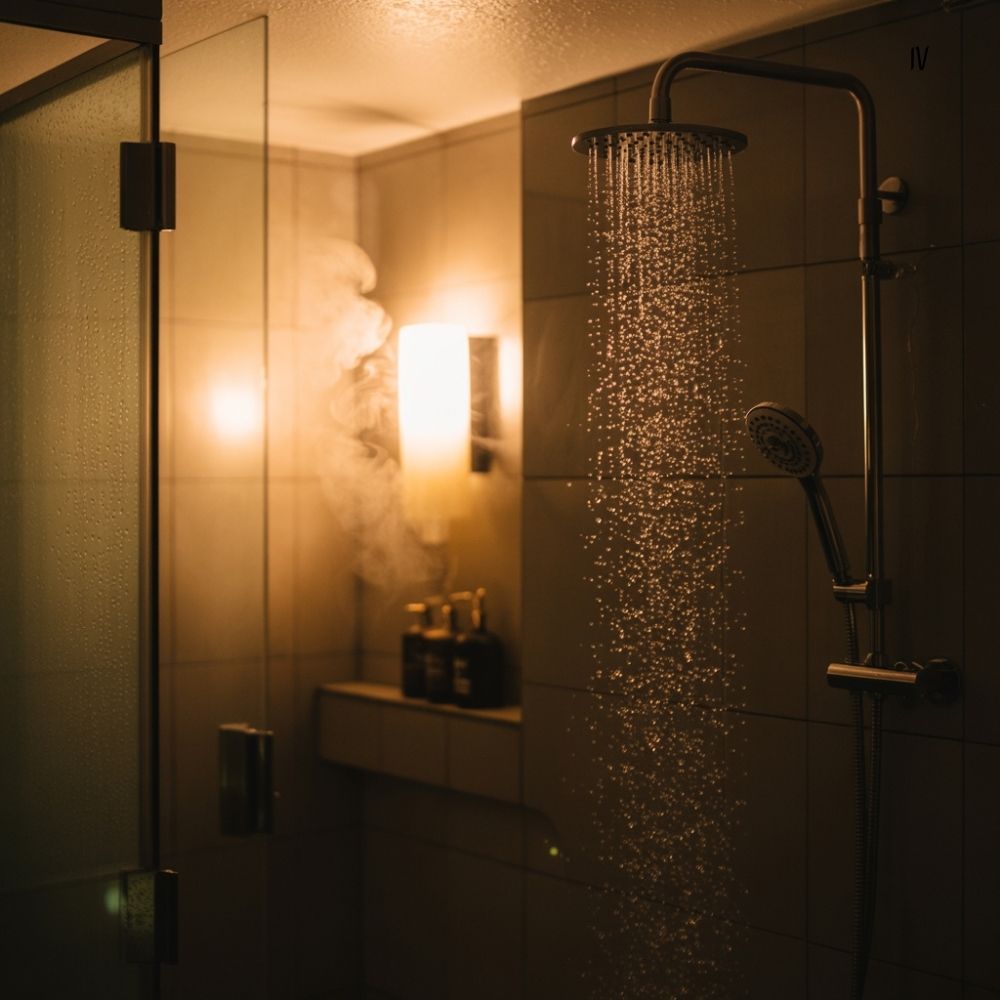
Step 1: I dim the bathroom before I start
This is small, but it matters. I don’t like harsh light when I’m mentally loud because it makes everything feel more urgent.
If it’s evening, I turn on the softest light available, and if it’s daylight, I sometimes leave the main light off entirely. I’m not trying to create ambiance. I’m trying to reduce visual input so my brain has fewer things to react to.
I also leave my phone in another room. If my mind is loud, my phone will not help, and I know this about myself now.
Step 2: I start warm, but not aggressively hot
I begin with warm water that feels comforting but not punishing. Overly hot water can feel good in the moment, but it can also make me lightheaded and more irritated afterward. Warm is enough to soften the body. Warm is enough to signal safety. I don’t need intensity.
I stand under the water for a full thirty seconds without doing anything else, and this is not a meditation practice, it is simply me letting my body register that the environment has changed.
Step 3: I wash in a specific order so my brain stops improvising
When my mind is loud, improvising turns into wandering, and wandering turns into more time to think, so I keep the order consistent.
I wash my hair first if it needs washing, because shampoo requires the most effort and I’d rather do it before my arms get tired. I use a gentle shampoo and I do not scrub aggressively.
I massage the scalp with my fingertips in slow circles, mostly at the crown and behind the ears, because those are the places where tension sits quietly. If I’m not washing my hair, I still wet it slightly and press water through it, because it makes me feel “reset”.
Then I rinse thoroughly, because leftover product makes me itchy, and itchiness makes my mind louder, which is exactly what I’m avoiding.
I wash my body next with an unscented or lightly scented wash, and I use my hands, not an abrasive cloth. This is not a “deep clean” shower. It is a calming shower. I want the sensation to be smooth and minimal, like wiping down a surface rather than scrubbing it.
Step 4: I do one gentle grounding step, and I keep it the same every time
My grounding step is one of two options depending on what I need, and I don’t overthink it because overthinking is the enemy.
If I feel anxious and buzzy, I do a slow rinse at the end, letting water run down the back of my neck and shoulders for about twenty seconds, and I breathe out longer than I breathe in, because longer exhales encourage the body to settle.
If I feel heavy and flat, I do a slightly cooler rinse for ten seconds, not icy, just cooler than the rest of the shower, because that small contrast wakes the body gently without sending it into stress. It gives me a clean edge, like opening a window.
Then I turn off the water and I exit the shower without lingering. Lingering becomes thinking time, and thinking time becomes noise again.

The hack: how I keep the calm from evaporating when I step out
Here is the practical hack I always use, and it is the part that makes the routine actually work beyond the shower itself.
I wrap myself in a towel and I do not check anything for two minutes, not messages, not the mirror, not the to-do list in my head. Instead, I apply body lotion or body oil to my arms and shoulders while my skin is still slightly damp, using slow pressure rather than quick rubbing.
This does two things at once. It seals in moisture so I don’t get that dry, tight feeling that makes me uncomfortable later, and it gives my nervous system a steady, repetitive sensation that extends the calming rhythm of the shower into the next moment.
I prefer a fragrance-free lotion or something that smells clean and soft, because strong scent can feel like another loud voice. The product does not matter as much as the method, because the method is what tells the body, we are safe now, we are here, we are finished.
If I skip this step, I often feel the calm drop away as soon as I put on clothes, and then the mental noise returns, and the shower becomes a brief interruption rather than a reset. This is why the hack matters. It makes the calm stick.
Final Thoughts
When my mind is loud, I don’t need a perfect evening routine. I need something that interrupts the noise and returns me to my body without creating another performance to maintain.
My shower routine is built for that reality. It is warm but not punishing, simple but not careless, structured enough to guide me, and gentle enough to keep me from adding more stimulation.
I don’t always end the day completely calm, and I don’t expect that from myself anymore. I just want to be steadier than I was an hour ago, and this routine gets me there often enough that I trust it, which is the only kind of self-care I still keep.